How chess openings rose and fell, 1850 to 2026
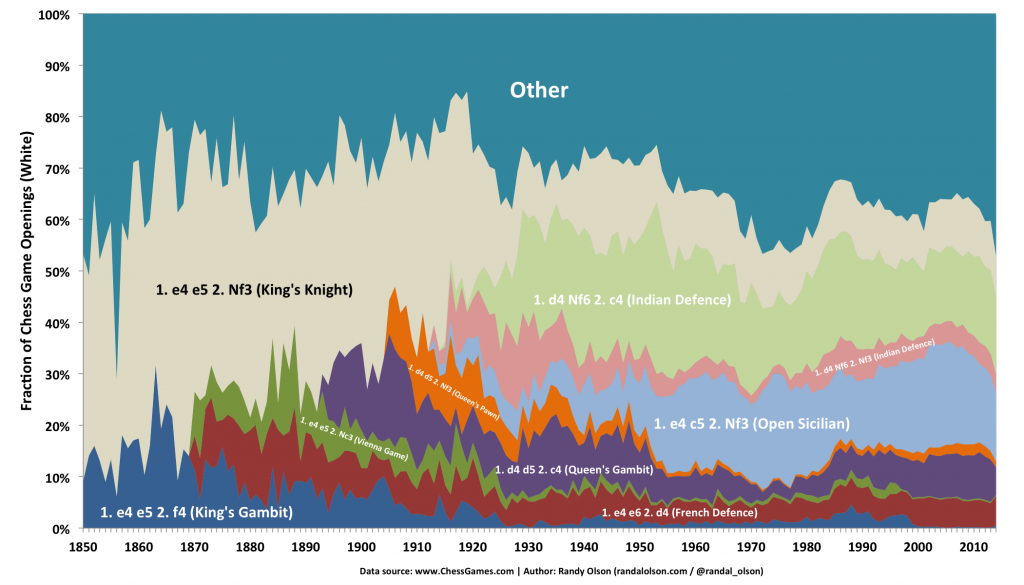
Back in 2014 I built a stacked area chart of chess opening popularity from 1850 to that year. It showed Black's reply to White's first move and stopped there: when I tried to push it to the next ply, the ribbons stacked into illegible noise. With another decade of master games on hand and a recursive streamgraph that keeps the same time axis at every depth, the version below picks up where that one stalled, and every ribbon opens into the lines beneath it.
The 100-year d4 challenge
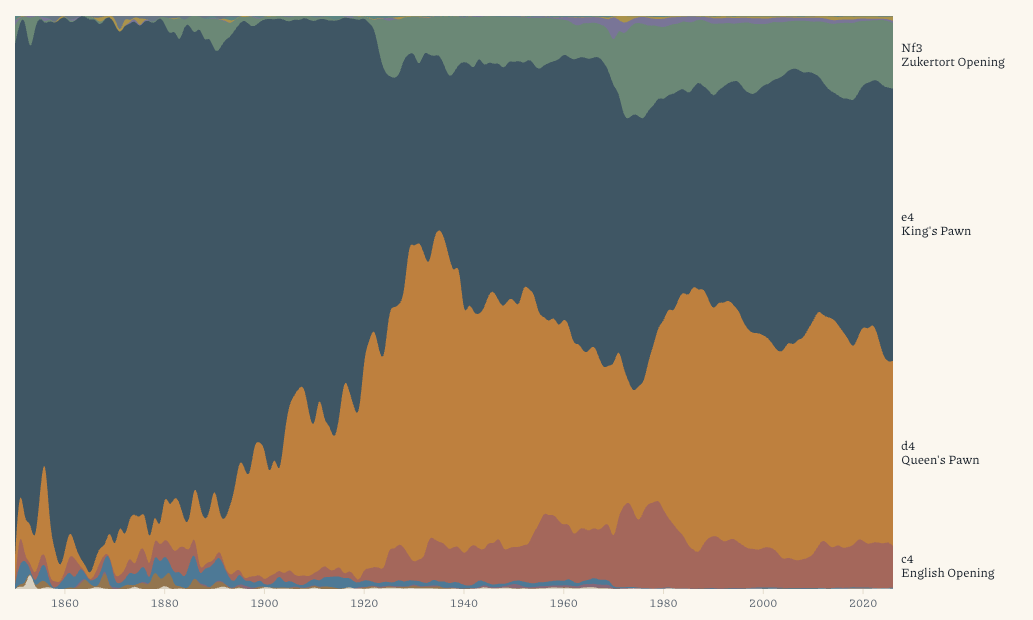
In the 1860s, 93% of the games in this corpus opened with 1.e4. By the 1940s that share had fallen to about 42%, with 1.d4 right alongside it at roughly the same number. Getting there took about 80 years of theory, three generations of world champions, and a completely different way of thinking about the center of the board.
The arc lines up with the eras chess writers have drawn for over a century. The Romantic era of Adolf Anderssen and Paul Morphy treated the center as ground to be seized in tactics; Morphy opened 1.e4 as White and answered 1.e4 with 1...e5 as Black, so nearly all of his games were open games. The Classical school of Wilhelm Steinitz, the first official world champion in 1886, and Siegbert Tarrasch traded sacrifices for positional principles but kept 1.e4 as the default. What finally broke the open-game monopoly was 1.d4, and a school that thought about the center in a completely different way.
The hypermodern wave
Click into 1.d4 in the chart and watch the 1...Nf6 ribbon. In the 1900s that reply turned up in under 3% of 1.d4 games. By the 1920s it was more than half of them, and it has been the majority answer to 1.d4 ever since. The Hypermodern school of the 1920s, named in Savielly Tartakower's 1924 book Die hypermoderne Schachpartie and codified by Aron Nimzowitsch's My System (1925–1927) and Richard Réti's Die neuen Ideen im Schachspiel (1922), made one claim above all: don't occupy the center with pawns, let your opponent push them out there and then attack them from the flanks with pieces.
The movement crested in the 1930s. That decade is 1.d4's high-water mark in the whole chart: it reached about 52% of all master games while 1.e4 fell to 33%. The Indian Defenses are what the theory looks like over the board. Black answers 1.d4 with 1...Nf6 instead of 1...d5, then often plays ...g6 or ...e6, fianchettoes a bishop, and hits White's center from the wings. The Nimzo-Indian, the King's Indian, and the Grünfeld all live inside that ribbon. In barely one generation, the hypermoderns took a piece of board geometry the Romantics had never seriously contested and made it the most common reply to 1.d4 by a wide margin.
The Sicilian takeover
The most dramatic single line in this corpus is what happened to 1.e4 c5. The Sicilian Defense sat between 5 and 10% of 1.e4 games for the chart's first 70 years. Then it climbed, and it did not stop: by the 1960s it was over 40% of every game that began 1.e4, and it has hovered between roughly 40 and 50% ever since. In the same stretch the open game 1.e4 e5 (the Italian, the Ruy Lopez, and the rest) fell from about 85% of 1.e4 games in the 1860s to barely a fifth by the 1990s.
The Sicilian's rise tracks a generation of players who built their names on it. Miguel Najdorf popularized the sharp 5...a6 line, which already existed, from the 1940s on, and it ended up carrying his name. Bobby Fischer made the Najdorf his main weapon against 1.e4 through the 1960s and early 1970s. Garry Kasparov leaned on the Sicilian, usually the Najdorf or a Scheveningen, as his main defense against Anatoly Karpov's 1.e4 across five world championship matches between 1984 and 1990. The open game was never refuted. The Sicilian just gave attacking players better practical results, and the field followed.
The fall of 1.e4 e5 has a twist worth chasing in the chart. Click into it and run it forward: after bottoming out near a fifth of all 1.e4 games in the 1990s, it climbs back to almost 40% by the 2020s, as engines made rock-solid lines like the Berlin and the Petroff respectable again.
Where things sit now
From the 1970s on, the top of the streamgraph goes quiet. 1.e4 holds about 43% of all games, 1.d4 about 37%, 1.Nf3 (which often transposes into one of the other two) about 11%, and 1.c4 about 7%. Engines reshaped how openings get studied, from Deep Blue beating Kasparov in 1997 to AlphaZero in 2017, a network that learned the game only by playing itself and grew its own opening tastes, leaning toward 1.d4 and the English in its later training. But the top-level shares have drifted by single digits across the whole engine era, nothing like the 30-point swings of the first century.
The action moved deeper. What changes now is which lines of the Sicilian and the Indian Defenses are in fashion, not whether to play them at all. Drill past the third or fourth move and the fights are everywhere: the rise and fall of the Najdorf English Attack, the Berlin Defense roaring back after Vladimir Kramnik used it to take Kasparov's title in 2000, the Ragozin slowly eating into the Queen's Gambit Declined. For the chart's first hundred years the question was which first move to play. For the last fifty it has been how deep the theory runs before someone finds new ground, and that is the question the recursive view was built to answer. Start at 1.e4 and see how far down you can go.
How this chart was made
The data is Lumbra's Gigabase OTB (CC BY-NC-SA 4.0), 1.2 million tournament games from 1850 to 2026 seen through a master-level strength lens: every recorded game before 1970, when FIDE Elo ratings began, plus games with both players rated 2400 or higher from 1970 on. The same strength lens was checked against the ChessGames.com data behind the 2014 post. The chart is built in D3.js as a recursive area chart: clicking a ribbon re-stacks its children on the same 177-year axis, the fix the 2014 version never had.

Dr. Randal S. Olson
AI Researcher & Builder
I’ve worked in AI for 15+ years, from academic research to production systems at startups. I’m building things independently for now.