Working your way through college now takes 5x more hours than in 1970
Part of Teaching an AI Agent to Make Beautiful Charts
In 2014, a rant about Michigan State University's tuition went viral and people pushed back, saying it was just one school. So I followed up with a proper analysis using national data. That post used IPEDS tuition data from 1987-2010 and found the same trend: a 1979 student could pay tuition with a part-time summer job (182 hours), while a 2013 student needed a full-time job for half the year (991 hours, extrapolated). Over 5x as many hours for the same education.
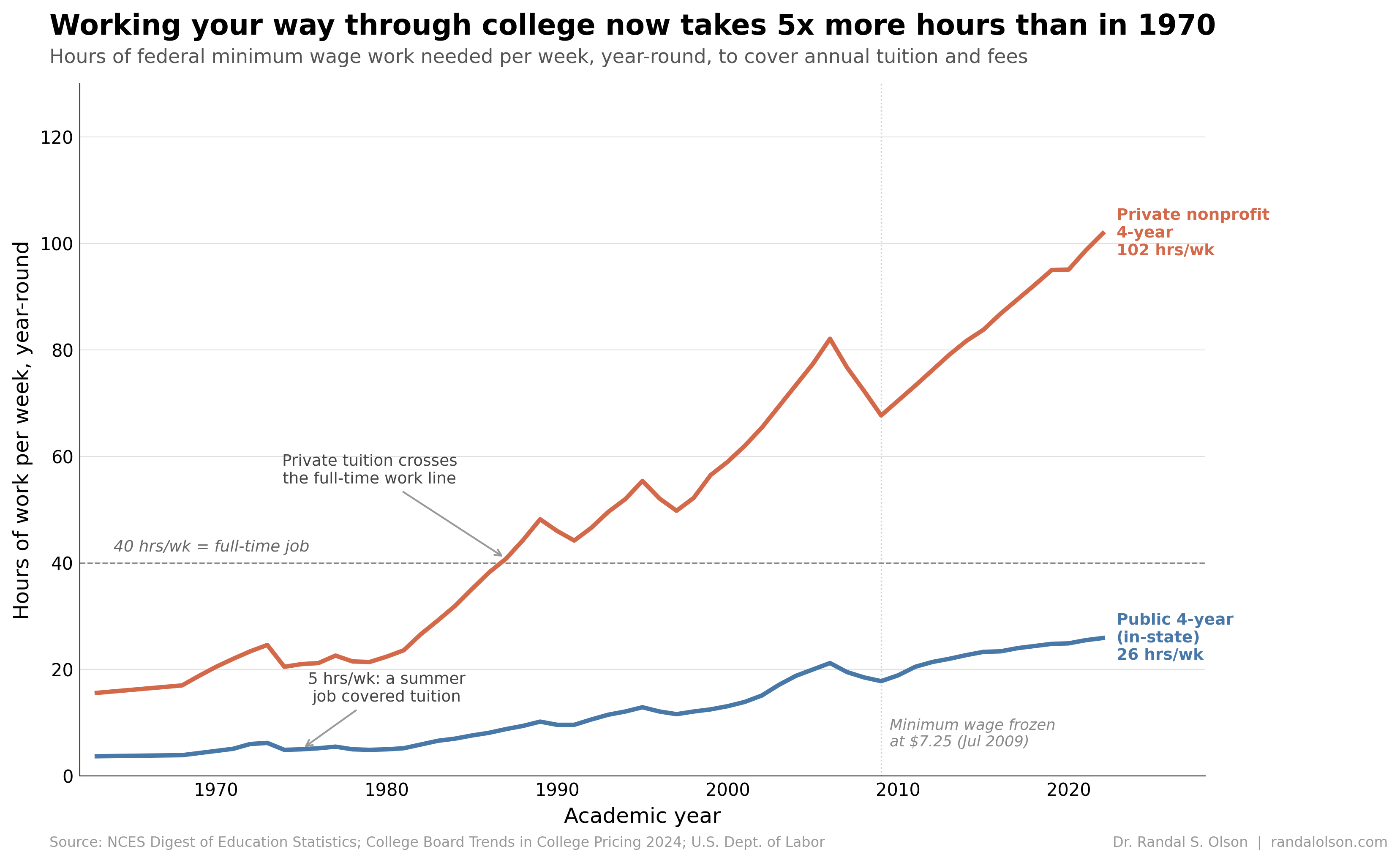
Twelve years later, the NCES data now goes back to 1963 and forward to 2023, and I added private universities to the picture. I pulled tuition data from the NCES Digest of Education Statistics, combined it with federal minimum wage history, and calculated hours per week a student would need to work year-round to cover annual tuition and fees. The actual 2013 data, by the way, came in at 1,147 total hours, worse than the 991 my model had predicted.
A summer job used to cover tuition
Through the 1970s and into the early 1980s, a student at a public university could cover annual tuition with about 5 hours of minimum wage work per week. That's roughly 260 hours total for the year. A full-time summer job at minimum wage paid about 520 hours. Tuition was covered with room to spare.
This was the era people mean when they say "I worked my way through college." They're not wrong about their own experience. Public university tuition in 1970-71 was $394. The federal minimum wage was $1.60/hour. The math worked.
Two forces broke the math
Look at the public line in the early 1980s. It starts climbing right when Congress froze the federal minimum wage at $3.35 in 1981, where it stayed for nine years. Tuition kept rising while the wage floor sat still, and the hours needed nearly doubled from 5 to 10 by 1990. Sound familiar? The same thing is happening right now with the post-2009 freeze.
Then states started pulling back their funding. From 2000 to 2015, state funding per student fell roughly 30% after adjusting for inflation, according to Pew. The Center on Budget and Policy Priorities found that published tuition at four-year public colleges rose 35% in the years following the 2008 recession, as states slashed budgets and never fully restored the funding. Universities passed the shortfall directly to students.
Private tuition crossed the full-time work line in 1988
In the 1987-88 academic year, covering private university tuition first required more than 40 hours of minimum wage work per week, year-round. More than a full-time job, just for tuition. No food, no rent, no books. That was nearly 40 years ago, and it has only gotten further out of reach since.
By 2022-23, private nonprofit tuition required 102 hours of minimum wage work per week. There are only 168 hours in a week. Working your way through private school stopped being difficult a long time ago. It is now physically impossible.
Minimum wage increases help, then the freeze makes it worse
The chart shows something interesting around 2007-2009. Congress raised the minimum wage in three steps, from $5.15 to $7.25, and the hours needed to cover private tuition dropped from 82 to 68 per week. Minimum wage increases actually work as temporary relief. Then the freeze started, and by 2022 the line had climbed past 100.
The federal minimum wage has been $7.25 since July 24, 2009. That's the longest period without an increase since the minimum wage was established in 1938. During that same period, average public university tuition rose from $6,717 to $9,750, a 45% increase, while the wage stayed frozen. Thirty states and D.C. have set their own minimum wages above $7.25, but students in the remaining 20 states are stuck with a rate that hasn't moved in 17 years.
Where things stand now
As of 2022-23, a student working at the federal minimum wage needs to work 26 hours per week, year-round, just to cover public in-state tuition and fees. That's before paying for housing, food, textbooks, or transportation. At a private nonprofit university, the number is 102 hours per week. The College Board's 2024-25 figures are even higher: $11,610 for public and $43,350 for private, which would push those to 31 and 115 hours per week respectively.
The next time someone tells a college student to "just work harder," show them this chart. The math that worked in 1975 stopped working decades ago.
How this chart was made
An AI agent built this chart end-to-end as part of the Beautiful Charts with AI series. It pulled tuition data from NCES, combined it with federal minimum wage history, and iterated on the design until it passed the Tufte Test, a data visualization quality standard built by Goodeye Labs on Truesight.
Data sources: NCES Digest of Education Statistics, Table 330.10 (tuition and required fees, 1963-64 through 2022-23) and U.S. Department of Labor (federal minimum wage history). The full dataset and Python script are available here.
Beautiful Charts with AI
Want to test your own charts against the same quality bar?
Try the Tufte Test on your own chart, or get future updates on AI evaluation and chart quality from Goodeye Labs.

Dr. Randal S. Olson
AI Researcher & Builder · Co-Founder & CTO at Goodeye Labs
I turn ambitious AI ideas into business wins, bridging the gap between technical promise and real-world impact.