Sabastian Sawe ran the first sub-2-hour marathon: 118 years of marathon records
Part of Teaching an AI Agent to Make Beautiful Charts
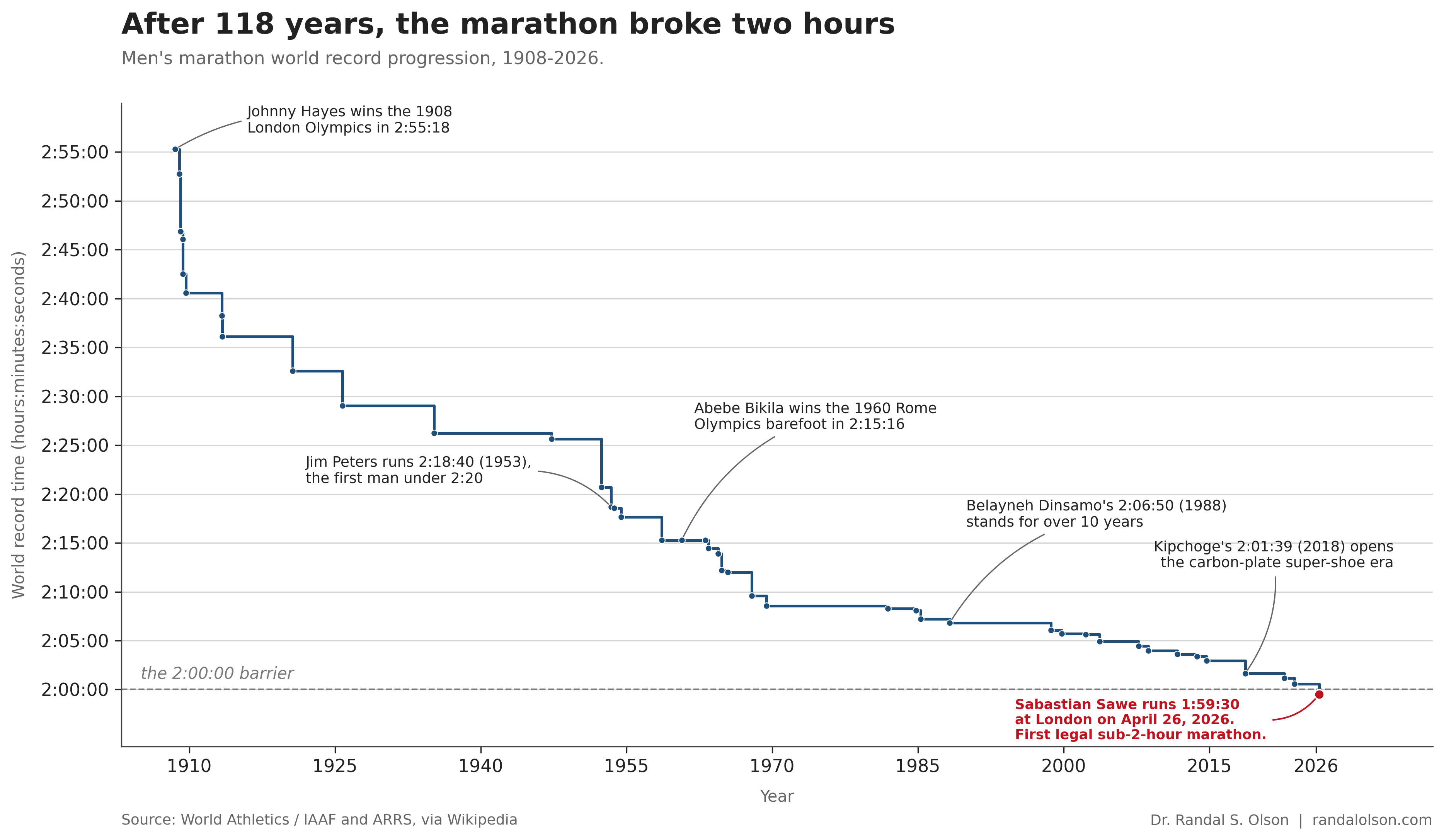
This morning in London, Kenya's Sabastian Sawe ran the marathon in 1 hour, 59 minutes, 30 seconds. He took 65 seconds off Kelvin Kiptum's 2023 world record, and became the first man to break two hours in an open, record-eligible marathon. The chart below puts that performance in the context of the men's world record line going back to the first Olympic marathon in 1908.
The 1908 Olympics set both the distance and the first record
Johnny Hayes of New York won the 1908 London Olympic marathon in 2:55:18, the first official world best at the modern marathon distance. He inherited the gold from Italy's Dorando Pietri, who finished first but was disqualified after officials propped him up and helped him across the line in front of the Royal Box.
The 26 mile, 385 yard distance came from a royal request, not a measured course. Princess Mary asked for the race to start on the East Lawn of Windsor Castle so the royal children could watch from the nursery window, and the finish was placed in front of the Royal Box at the new White City stadium. The exact distance between those two points became the marathon, and the IAAF (now World Athletics) formally adopted it as the standard in 1921.
1953: Jim Peters runs the first sub-2:20
The first half-century of the record looks slow on the chart because almost no one was racing the marathon as a serious event. Most early world bests came from a handful of one-off long-distance races and Olympic finals. The pace of progress accelerated after World War II, and the runner who carried it was an unsponsored optician from Essex named Jim Peters.
Peters set the world record four times between 1952 and 1954. His 2:18:40 at the Polytechnic Marathon in June 1953 was the first marathon under 2:20, and he kept lowering his own mark, ending with 2:17:39 a year later. The 2:17:39 stood as the world best for four years. Peters never won an Olympic medal. He collapsed within sight of the finish at the 1954 Empire Games and never raced a marathon again.
1960: Abebe Bikila wins barefoot in Rome
Abebe Bikila of Ethiopia ran the 1960 Rome Olympics in 2:15:16 without shoes. The popular story is that this was a gesture; the actual reason was simpler. Adidas, the official Olympic shoe supplier, had run out of shoes that fit him by the time he arrived to collect his pair. The shoes he was given gave him blisters in training, so on race day he left them off.
Bikila was the first sub-Saharan African to win an Olympic gold medal. He defended his title four years later in Tokyo, this time in shoes, and broke the world record again with a 2:12:11. The chart's annotation points to the 1960 run because that was the moment African distance running stepped onto the world stage; the dominance has not stopped since.
1988: Dinsamo's record holds for a decade
Belayneh Dinsamo of Ethiopia ran 2:06:50 at Rotterdam in April 1988. The record stood for 10 years, 5 months, and 3 days before Ronaldo da Costa of Brazil finally took it at Berlin in 1998. That decade is the longest gap between world records since the 1930s. The 1990s saw a generation of runners chase the mark and miss; East African road racing depth was exploding, but no one could put a single race together at the right pace on the right course.
Da Costa's 2:06:05 in Berlin opened the modern era of the marathon record. Of the next 10 men to break it, eight were from Kenya or Ethiopia (Khalid Khannouchi of Morocco and the U.S. is the only other name on the list). The race that broke it most often was Berlin, a flat, fast, late-season course that has seen nine world records since 1998.
The Vienna asterisk: Kipchoge 1:59:40 in 2019
The 2:00:00 line on the chart was nearly crossed seven years ago. On October 12, 2019, in a Vienna park, Eliud Kipchoge of Kenya ran 1:59:40 with a rotating phalanx of 41 pacemakers, a pace car projecting a green laser line on the road, and hydration handed off from a moving bicycle. The event, called the INEOS 1:59 Challenge, was designed entirely around producing a sub-2 time.
World Athletics did not ratify the run as a record because it was not an open competition. Guinness recognized it as a category of its own. The performance proved the human body could cover 26.2 miles in under two hours; what it did not prove was that anyone could do it in a normal race against other runners, with normal hydration and no escort. That is what stayed open for the next seven years.
The super-shoe era
The line on the chart drops sharply after 2017 for a reason. Nike released the Vaporfly 4% that year, the first carbon-plated, foam-stacked racing shoe. Researchers at the University of Colorado measured a 4% improvement in running economy in 18 sub-elite runners; the study was Nike-funded but the methodology held up under independent replication.
Kipchoge ran 2:01:39 in the Vaporfly at Berlin in 2018. Kiptum ran 2:00:35 in a Nike Alphafly at Chicago in 2023. Every world record in the men's marathon since 2017 has been set in a carbon-plated shoe. Every major shoe brand now sells one. The shoes are not the only reason the record has fallen this fast, but the chart's slope from 2017 forward is steeper than anything in the previous 40 years.
Kelvin Kiptum should have been the one
The runner most expected to break two hours was Kelvin Kiptum. He debuted at Valencia in December 2022 in 2:01:53, the fastest debut marathon in history. He won London in April 2023 in 2:01:25, then set the world record at Chicago that October in 2:00:35, at age 23. He was scheduled to attempt sub-2 at Rotterdam in April 2024.
He never ran it. Kiptum died on February 11, 2024, in a car crash near Kaptagat, Kenya, alongside his coach Gervais Hakizimana. World Athletics had ratified his world record five days earlier. His record stood for two and a half years, longer than the careers of most elite marathon runners last.
April 26, 2026: the barrier finally falls
Sawe came through halfway in 1:00:29 with Yomif Kejelcha of Ethiopia, both running under world record pace. Sawe broke away at 30K, ran his next 5K in 13:54, and covered the final 2.195K in 5:51, ten seconds faster than anyone has ever closed a marathon. His average pace was 4:33 per mile, for 26.2 miles in a row. The course in London is flat, the conditions were dry and cool, and the field was deep enough that Kejelcha finished second in 1:59:41 to become the second man under two hours.
What changes from here is the framing. The 2:00:00 line was the last round-number barrier in the marathon, the running equivalent of Roger Bannister breaking 4:00 in the mile. Bannister ran his 3:59.4 on a cinder track at Oxford in May 1954; 46 days later, John Landy ran 3:58.0. Within three and a half years, Derek Ibbotson had taken the mile world record down to 3:57.2. The pattern after a barrier falls is usually that the next runner gets there faster.
How this chart was made
An AI agent built this chart end-to-end as part of the Beautiful Charts with AI series. It researched the data, built the chart in Python, and iterated on the design until it passed its own chart-quality review.
Data source: Marathon world record progression on Wikipedia, drawing on World Athletics and the Association of Road Racing Statisticians. The full dataset is available here.

Dr. Randal S. Olson
AI Researcher & Builder
I’ve worked in AI for 15+ years, from academic research to production systems at startups. I’m building things independently for now.