U.S. women 40+ now have more babies per capita than teens
Part of Teaching an AI Agent to Make Beautiful Charts
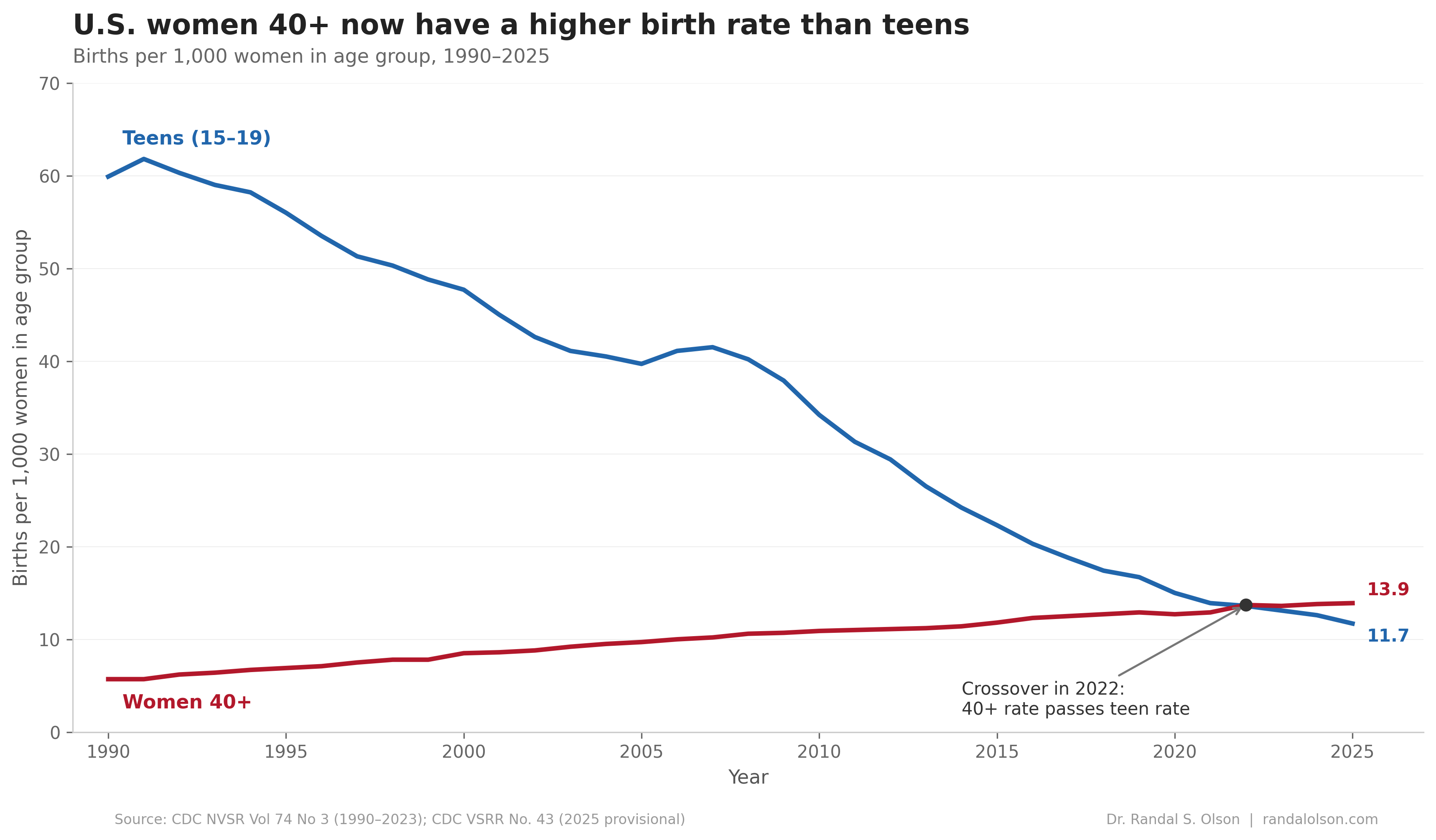
30 years ago, teen pregnancy was a defining anxiety of U.S. public health. Having a baby at 40 was rare and often medically discouraged. Today those positions have flipped. U.S. women in their 40s now give birth at a higher rate than U.S. teenagers. The rates crossed in 2022, and the gap is widening every year.
Teen pregnancy stopped making headlines
In the early 1990s, the teen birth rate hit a modern peak that public health agencies treated as a generational crisis. Then it started falling, almost every year, for 30 years. By 2025, it had dropped by more than 80%, one of the steepest sustained declines in U.S. public health data.
The reasons are unglamorous but well documented. Long-acting reversible contraceptives like IUDs and implants went from rare to routine for the teens who wanted them. Their use rose more than 15-fold between 2005 and 2013, according to the CDC. Sex education improved. Teens started having sex later. The CDC's National Survey of Family Growth shows the share of female teens who had ever had sex fell from 51% in 1988 to 42% by 2017. None of this happened in a single dramatic moment. It accumulated, year after year, until the social problem that had once defined U.S. public health policy had largely solved itself.
Older motherhood became ordinary
The other half of the chart tells a different story. Women started families later, and they kept doing so. The mean age at first birth in the U.S. rose from 24.9 in 2000 to 27.5 in 2023, pushing more first births past 35 and a meaningful share past 40.
At the same time, reproductive medicine moved from boutique to mainstream care. IVF clinics opened in every major metro. Egg freezing crossed a key threshold in 2012, when the American Society for Reproductive Medicine officially dropped its "experimental" label, and uptake climbed sharply afterward. The CDC counted more than 97,000 ART-conceived infants in 2021, more than double the 2003 count. Becoming a mom at 40, 42, or 45 is no longer the exception. It is supported by an entire medical industry that scarcely existed a generation ago.
The lines crossed in 2022, and they haven't come back
For the entire span of modern U.S. vital statistics, going back to 1933, teen births had outnumbered births to women 40 and older, often by a wide margin. The 2022 crossover was a first. What's happened since is more telling than the moment itself. The gap has widened every year. The chart shows two arcs that came from opposite directions, met in 2022, and haven't reversed.
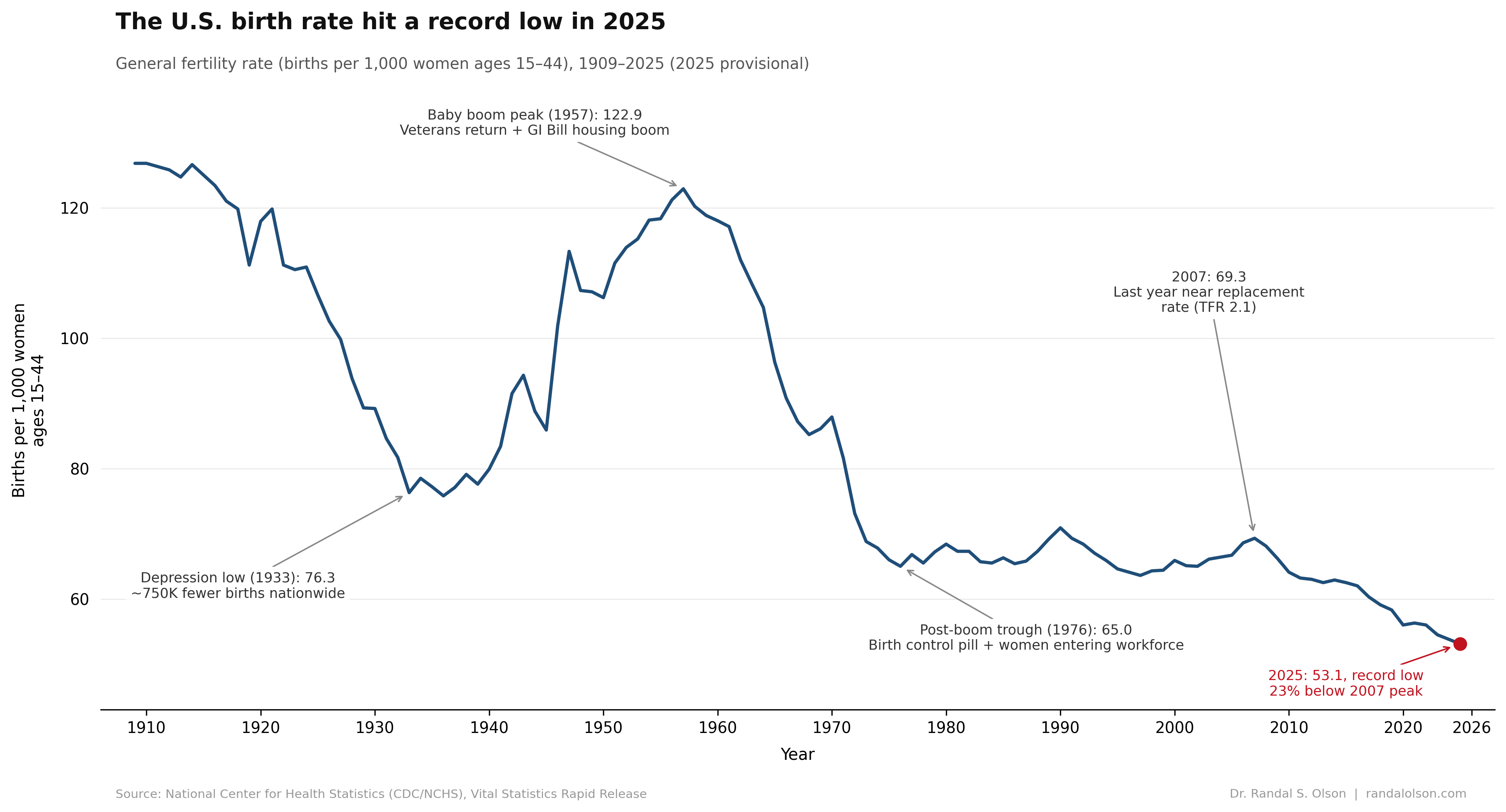
This crossover sits inside a larger fertility shift. In the U.S., the general fertility rate hit a record low in 2025, and the total fertility rate has been below replacement since 2009. I wrote about that macro picture and what it means for U.S. population growth in another post.
How this chart was made
An AI agent built this chart end-to-end as part of the Beautiful Charts with AI series. It researched the data, built the chart in Python, and iterated on the design until it passed the Tufte Test, a data visualization quality standard from Goodeye Labs. The workflow behind it is public: run the same high-signal chart workflow to make your own.
Data sources: CDC National Vital Statistics Reports, Vol. 74, No. 3 (Driscoll & Hamilton, March 2025), Table 2, for 1990 to 2023; CDC Vital Statistics Rapid Release Report No. 43 (Hamilton, Osterman & Gregory, April 2026), Table 1, for 2024 final and 2025 provisional rates. The 40+ series sums the CDC sub-rates for women 40-44 and women 45 and older (each per 1,000 women in age group). The 2025 figures are provisional and based on 99.95% of birth records received and processed by the National Center for Health Statistics as of February 3, 2026. The full dataset used for this chart is available here.
Beautiful Charts with AI
Make your own charts with the same workflow
Every chart in this series is built by the same public workflow. Fork it and run it yourself, then grade the result against the Tufte Test.

Dr. Randal S. Olson
AI Researcher & Builder · Co-Founder & CTO at Goodeye Labs
I’ve worked in AI for 15+ years. At Goodeye Labs, we build AI products that point frontier models at the business outcomes a team actually cares about.