In AI-exposed jobs, only the youngest workers are losing ground
Part of Teaching an AI Agent to Make Beautiful Charts
If AI were quietly thinning out jobs, you would expect the damage to spread across a workforce, not concentrate in a single corner of it. That is not what the payroll data shows. In the jobs most exposed to AI, employment for the youngest workers has dropped sharply since ChatGPT arrived, while everyone older in those same jobs kept right on growing.
The second cut is harder to wave away. Take those same 22-to-25-year-olds and look at the jobs AI can barely touch, and their employment went up, not down.
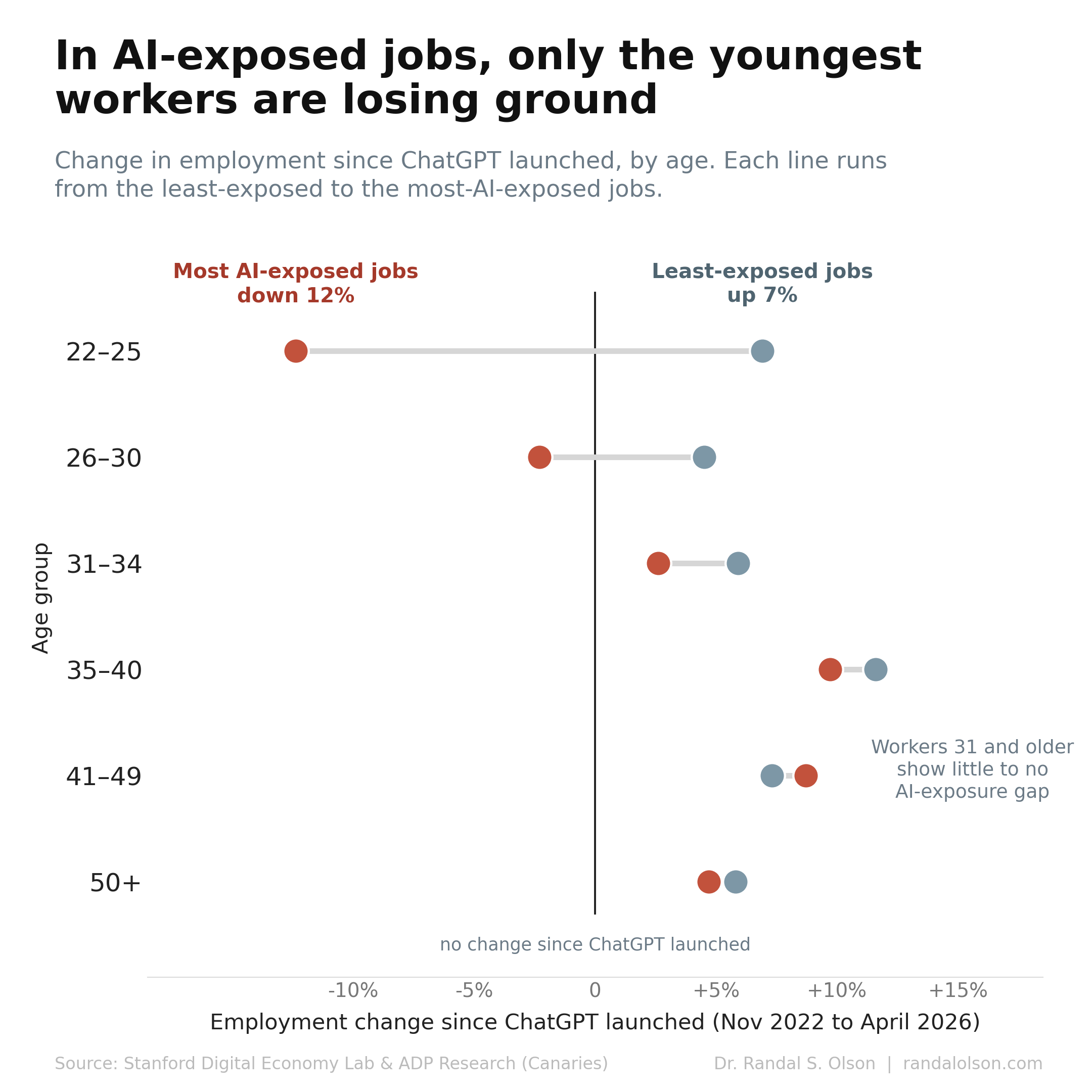
Each row is an age group. Within it, the dots show how employment has changed since November 2022, when ChatGPT launched: red for the most AI-exposed jobs, gray for the least-exposed. The wider the gap between the dots, the more a worker's exposure to AI seems to matter. For the youngest workers that gap is a chasm. For everyone else it nearly vanishes.
A job's AI exposure is a research measure of how much of its everyday work an AI model can do or speed up. Software developers, customer service reps, and accountants are among the most exposed; hands-on roles like home health aides and the skilled trades are among the least exposed.
The youngest workers are the only ones sliding
In the most AI-exposed jobs, employment for 22-to-25-year-olds is down about 12% since ChatGPT launched, while every age group 31 and up grew. The next group, 26 to 30, is roughly flat. After that the line only points up: workers in their 30s, 40s, and 50s all gained ground in the exact same high-exposure jobs.
The Stanford researchers who first flagged this have a clean explanation for why youth is the dividing line. Entry-level work leans on codified knowledge, the kind you can write down in rules and learn from a textbook, which is exactly what an AI model does well. Experienced workers lean on tacit knowledge, the judgment and context you only pick up on the job, which AI still fumbles. The junior tasks are the automatable ones, so the junior rungs are the ones being sawed off.
It is the AI-exposed jobs, not a bad year to be young
The same 22-to-25-year-olds grew about 7% in the least-exposed jobs, a swing of nearly 20 percentage points across the exposure scale. If this were just a rough market for young people in general, it would drag down the young everywhere. Instead it bites only where AI bites.
It also does not look like mass firing. Both the Stanford team and the Dallas Fed, working from separate data, find the decline comes from a collapse in hiring rather than layoffs: young people are not being shown the door so much as never let in. Software development is the sharp end of it, where employment for developers aged 22 to 25 has fallen close to 20% from its late-2022 peak. The on-ramp is what broke, and it is the same on-ramp recent graduates have been struggling to find for a few years now.
Experience is still a shield
For workers 31 and older, AI exposure barely registers: the gap between the least- and most-exposed jobs is a few points at most. For 41-to-49-year-olds it actually tips the other way, with the AI-exposed jobs slightly ahead.
That is the part that should reassure mid-career workers and worry new ones. The people who already cleared the entry-level gauntlet are insulated, because what they know is hard to hand to a model. The people trying to clear it now are competing with a tool that does the starter tasks for free.
How much of this is actually AI?
Here is where the honest version gets complicated, and the researchers are the first to say so. The same Stanford group later re-checked their own work and found the AI-exposed decline only turns statistically clean from 2024 onward; part of the earlier drop was probably something else, and they flatly state they do not think AI is the sole cause. Interest rates do not rescue the story either, since the exposed jobs are, if anything, less rate-sensitive than the rest.
And not everyone is convinced there is a signal here at all. The Yale Budget Lab finds no clear link between AI exposure and employment or unemployment through August 2025, and a New York Fed study of job postings sees little sign of a distinct AI-driven drop in demand, noting the relative slide in AI-exposed roles started before ChatGPT shipped. The name researchers gave this pattern, canaries in the coal mine, is the right frame: a canary is an early warning, not a verdict. The youngest workers are where the effect would show up first if it is real, and right now they are the ones gasping.
How this chart was made
This chart was built and self-critiqued by an AI agent. See the full series: Teaching an AI Agent to Make Beautiful Charts.
Data source: the Canaries dashboard from the Stanford Digital Economy Lab and ADP Research, built from anonymized ADP payroll records for about 25,000 firms. The Employment Index is set to 100 at November 2022 and broken out by age group and by occupational AI-exposure quintile; this latest release runs through April 2026. The cleaned dataset is available here.

Dr. Randal S. Olson
AI Researcher & Builder
I’ve worked in AI for 15+ years, from academic research to production systems at startups. Now I’m building independently and shipping projects I’d want to use myself.