No horse has broken Secretariat's 1973 Kentucky Derby record
Part of Teaching an AI Agent to Make Beautiful Charts
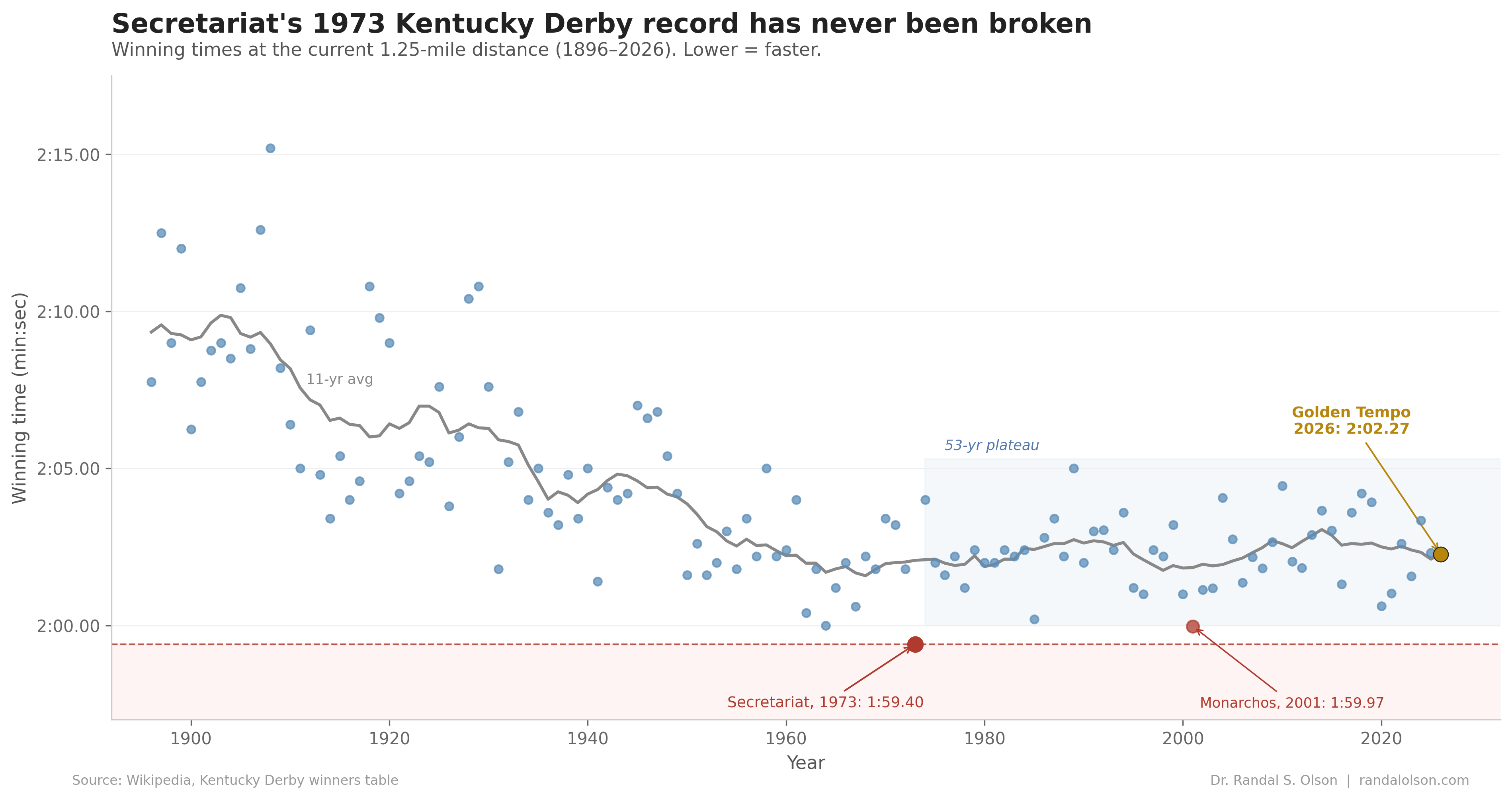
Golden Tempo crossed the finish line Saturday at Churchill Downs in 2:02.27, becoming the 2026 Kentucky Derby champion under first-time female trainer Cherie DeVaux. But look at the time. 2 minutes, 2 seconds. The record set by Secretariat in 1973, 1:59.40, was not touched. It hasn't been for 53 years.
From 2:08 to 2:00: 70 years of steady improvement
The Kentucky Derby ran at 1.5 miles from its founding in 1875 through 1895. In 1896 the distance was shortened to 1.25 miles, and the modern time series begins there. The first winner at the new distance, Ben Brush, ran 2:07.75.
What followed was a long decline in times. Better breeding programs, improved track surfaces, and more refined training methods all pulled times lower across the first half of the 20th century. By the 1930s, winners were regularly in the 2:03 to 2:05 range. By the early 1960s, they were approaching 2:00. In 1964, Northern Dancer ran 2:00.00 flat, arriving at the barrier but not crossing it. Over roughly 70 years, the winning time dropped by about 8 seconds.
What Secretariat did in 1973
Secretariat's 1:59.40 on May 5, 1973 was the first sub-2:00 Derby ever run. It remains the only one, with one near-miss: Monarchos in 2001 finished in 1:59.97, the closest any horse has come in the 53 years since.
What separated Secretariat wasn't just the clock. He ran each quarter mile faster than the one before, a pattern almost no horse at any distance sustains through the final stretch. When Dr. Thomas Swerczek performed the necropsy in 1989, he found a heart estimated at roughly 22 pounds, about 2.5 times the average thoroughbred heart of around 8 to 9 pounds. The chambers and valves were structurally normal; the organ was simply larger than any Swerczek had seen. Track conditions mattered too: both Secretariat in 1973 and Monarchos in 2001 ran on fast, dry tracks with no measurable precipitation in the prior 24 hours.
53 years without improvement
After 1973, the trend line goes flat. The 11-year moving average settles between 2:01 and 2:03 and stays there across 5 decades. Since 1973, only three horses have broken 2:01: Monarchos (1:59.97 in 2001), Spend A Buck (2:00.20 in 1985), and Authentic (2:00.61 in 2020).
The plateau isn't a Derby quirk. Research on thoroughbred performance across elite races finds that winning times showed minimal improvement after the mid-20th century, while human sprint and distance records kept falling for decades more. Part of the explanation is structural: thoroughbreds have generation intervals of around 10 to 11 years and relatively low heritability for racing speed, which limits how fast selective breeding can push race times lower. Horses are also bred to win races, not set records. Trainers and jockeys optimize for relative position in the field, not absolute time on the clock.
Golden Tempo and what 2026 confirms
Golden Tempo's win was remarkable in its own right. A 23-1 longshot sitting in last place through the far turn, he swept the entire field in the stretch. His trainer, Cherie DeVaux, became the first woman to train a Kentucky Derby winner in the race's 152nd running.
His time, 2:02.27, was completely ordinary for the modern era. That's not a knock on the horse. It's just where the Derby has lived for over 50 years. The best thoroughbreds in the world, trained with every modern tool available, consistently run the 1.25-mile Churchill Downs course in about 2:01 to 2:04. The sub-2:00 zone belongs to Secretariat and one exceptional May afternoon in 2001. Nothing since has come close.
How this chart was made
An AI agent built this chart end-to-end as part of the Beautiful Charts with AI series. It researched the data, built the chart in Python, and iterated on the design until it passed the Tufte Test, a data visualization quality standard from Goodeye Labs. The workflow behind it is public: run the same high-signal chart workflow to make your own.
Data source: Wikipedia's Kentucky Derby winners table. Times cover the 1.25-mile distance only (1896 to 2026); the 1875 to 1895 races ran 1.5 miles and are excluded for comparability. The full dataset used for this chart is available here.
Beautiful Charts with AI
Make your own charts with the same workflow
Every chart in this series is built by the same public workflow. Fork it and run it yourself, then grade the result against the Tufte Test.

Dr. Randal S. Olson
AI Researcher & Builder · Co-Founder & CTO at Goodeye Labs
I’ve worked in AI for 15+ years. At Goodeye Labs, we build AI products that point frontier models at the business outcomes a team actually cares about.