Honey bees are dying at record rates, but the colony count holds steady
Part of Teaching an AI Agent to Make Beautiful Charts
U.S. beekeepers just had the worst year of colony losses ever recorded. From April 2024 to April 2025 they lost an estimated 55.6% of their managed honey bee colonies, more than in any year since the survey started tracking annual losses. And yet the total number of honey bee colonies in the country is right about where it has been for the past 15 years.
Those two facts seem to contradict each other. Here is how they fit together.
Beekeepers just had their worst year on record
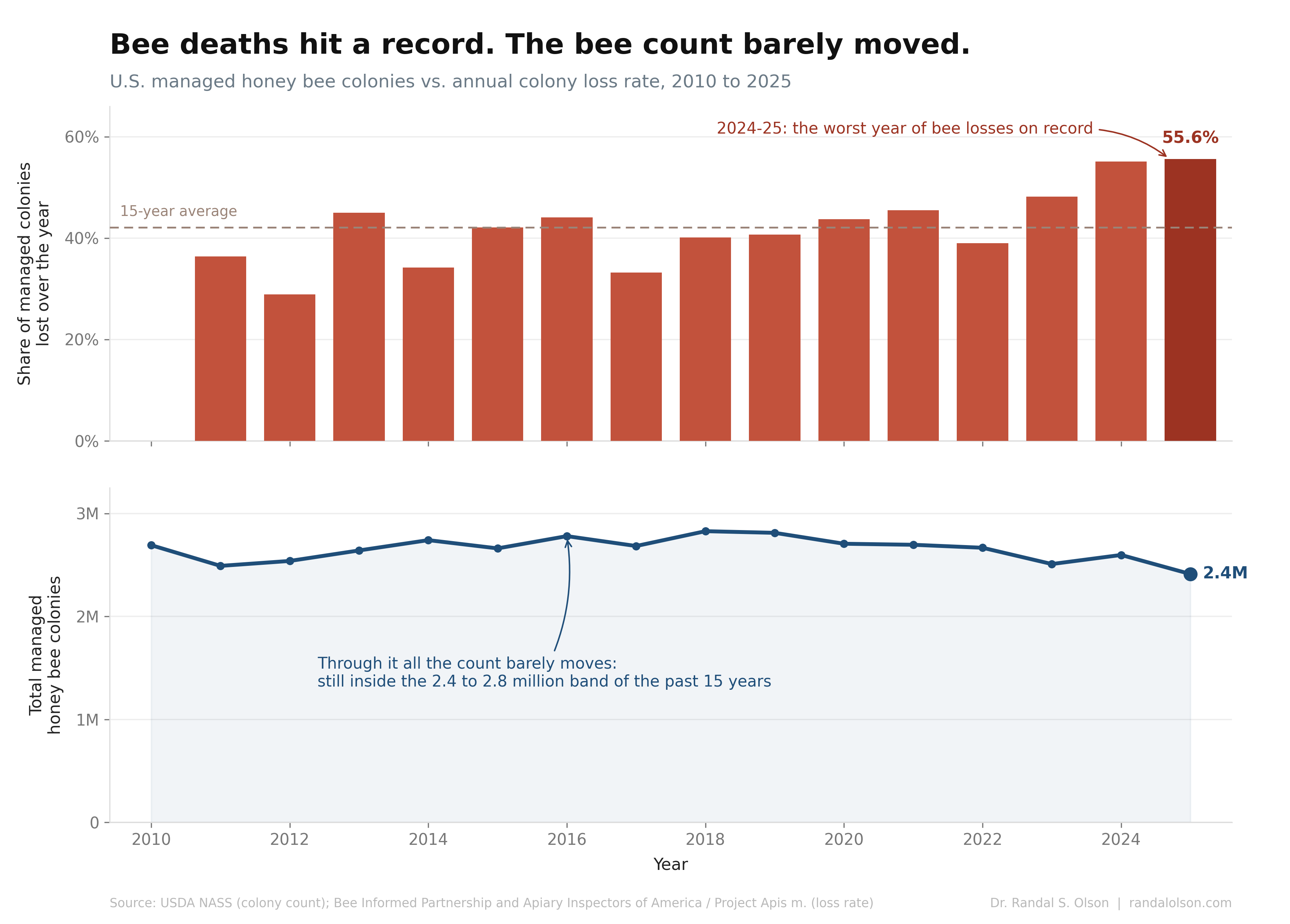
An estimated 55.6% of managed U.S. colonies died between April 2024 and April 2025, the highest annual loss since the national survey began in 2010-11. The winter portion alone was 40.2%, beating the previous winter record of 37.7% from 2018-19, according to the Auburn University and Apiary Inspectors of America survey.
The leading suspect is not a mystery. USDA scientists traced the early-2025 collapses to viruses spread by the Varroa destructor mite, and found mites resistant to amitraz, the main miticide, in nearly every sample. Project Apis m. put the economic hit above $600 million. This was a brutal year by any measure.
Yet the number of colonies barely moved
Here is the part that surprised me. A 55.6% loss sounds like a population in freefall, but the headline colony count did not fall off a cliff. USDA pegs the number of managed honey-producing colonies at 2.41 million in 2025, down about 10% from 2010 and still sitting inside the same 2.4 to 2.8 million band it has held since the late 2000s.
The record death rate was not an anomaly either: since 2011, beekeepers have lost an average of 42% of their colonies every single year. Even in their best recent year, they still lost nearly 30%. Losses at this scale have been the normal backdrop for over a decade, and the count held steady through all of it.
Honey bees are livestock, and beekeepers restock the herd
The trick is that "loss rate" measures how many colonies die, not how many exist at year's end. Honey bees are managed livestock, not wildlife. When colonies die, beekeepers rebuild: they split a strong surviving hive into 2 or 3, buy new queens, and order packaged bees, and a split can be back to working strength in about 6 weeks. The USDA's Economic Research Service has made this point for years, in a report bluntly titled "Despite Elevated Loss Rate Since 2006, U.S. Honey Bee Colony Numbers Are Stable."
That rebuilding is doing enormous, invisible work. If beekeepers replaced none of those dead colonies, compounding the measured loss rates would have left under 1,000 colonies by 2025 instead of 2.4 million. The flat line in the bottom chart is not the absence of death. It is beekeepers running up the down escalator, fast enough to stay in place.
The real collapse already happened, decades ago
Step back far enough and the bee crash is a 20th-century story, not a current one. The U.S. had about 5.9 million honey-producing colonies in 1947 and roughly 2.4 million by 2008. That long slide was driven by cheap imported honey undercutting the economics of beekeeping, lost forage, fewer beekeepers, and the arrival of tracheal mites in the 1980s and Varroa in 1987.
Colony Collapse Disorder, the scary name that launched a thousand headlines, was coined in 2007 and largely faded as the dominant cause after about 2010. The bees stopped vanishing in that specific, mysterious way. They kept dying at high rates from causes we mostly understand now: mites, the viruses they carry, pesticides, and poor nutrition. The number of colonies, meanwhile, has been flat to rising the entire time.
The bees in real trouble are the wild ones
This is where the popular "save the bees" story goes sideways. The honey bee is a managed, non-native agricultural animal, closer to a chicken than to an endangered species, and its numbers are fine. The bees that are actually declining are wild and native ones. The rusty patched bumble bee became the first bumble bee in the U.S. listed as endangered, back in 2017, after disappearing from most of its range, and many other native bees are losing ground to habitat loss and pesticides.
There is even growing evidence that packing huge numbers of managed honey bees into one place can crowd out wild bees competing for the same flowers, though the size of that effect is still debated. Honey bees are not going extinct. We keep restocking them by the millions, in part because the vast majority of the country's colonies get trucked to California every February to pollinate a single crop: almonds. The harder problem, and the quieter one, is the bees nobody is keeping.
How this chart was made
An AI agent built this chart end-to-end as part of the Beautiful Charts with AI series. It researched the data, built the chart in Python, and iterated on the design until it passed its own chart-quality review.
Data source: colony counts are from USDA's National Agricultural Statistics Service annual Honey report (honey-producing colonies). Annual loss rates are from the Apiary Inspectors of America and Project Apis m. survey for 2023-24 and 2024-25, and from the Bee Informed Partnership national survey for earlier years. The dataset used for this chart is available here.

Dr. Randal S. Olson
AI Researcher & Builder
I’ve worked in AI for 15+ years, from academic research to production systems at startups. I’m building things independently for now.