Curaçao is the smallest nation ever at a World Cup
Part of Teaching an AI Agent to Make Beautiful Charts
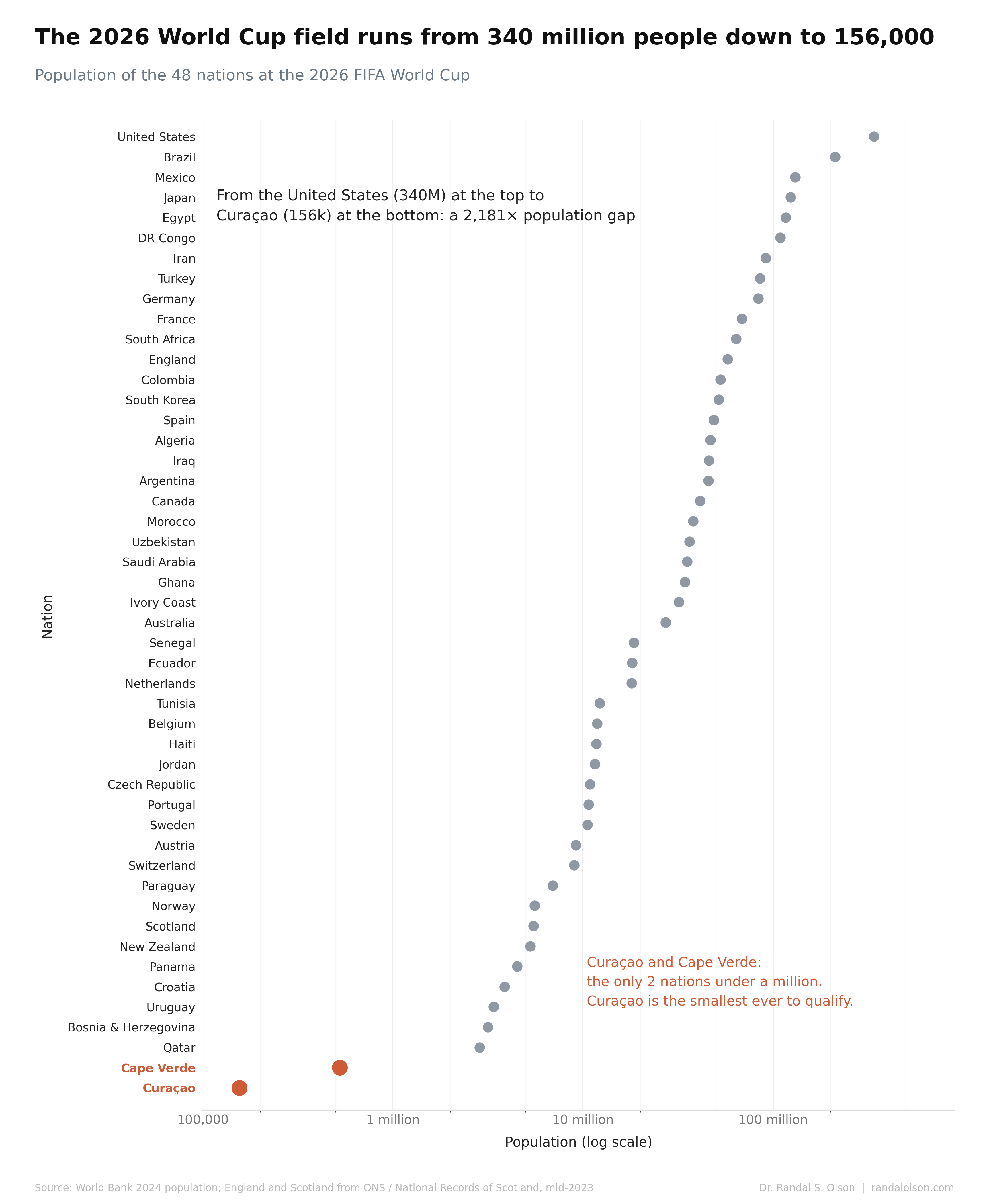
The 2026 World Cup kicks off on June 11 with the most lopsided field the tournament has ever assembled. The United States, the biggest of the 3 hosts, has about 340 million people. Curaçao, a Caribbean island in the same 48-team draw, has roughly 156,000. Curaçao's entire population would be a rounding error in the U.S. census.
Sort all 48 nations by population and the spread runs 2,181 to 1, top to bottom. That is hard to picture, so I plotted every nation in the field on a single scale.
Curaçao is the smallest nation ever to reach a World Cup
At about 156,000 people, Curaçao is the smallest country, by population and by land area, ever to make a men's World Cup. It takes the record from Iceland, which had around 350,000 when it reached the 2018 finals. The old record holder was more than twice Curaçao's size.
How an island of 156,000 pulls this off is its own story. Curaçao is a constituent country of the Kingdom of the Netherlands, and it leans hard on that link: all but one of the 26-man squad was born in the Netherlands, and 16 of them played for Dutch youth teams. Coached by veteran Dutchman Dick Advocaat, who will become the oldest manager in World Cup history, they qualified unbeaten and clinched it with a nervy 0-0 draw away at Jamaica in November.
A 48-team field changed who gets in
None of this happens in the old format. 2026 is the first World Cup with 48 teams instead of 32, the biggest expansion in the tournament's history. FIFA approved it in 2017 and pitched it as a way to make the game "truly global" and give more of its 211 member associations a realistic shot.
The new places did not fall evenly. Africa sent 5 nations to the 2022 World Cup and sends 10 this time; Asia rose from 6 to 9; Europe, already the biggest bloc, went from 13 to 16. The expansion was, in practice, an opening for smaller and less established football nations, which is how a single field can hold both the United States and Curaçao.
Cape Verde is the only other nation under a million
Curaçao is not alone at the bottom. Cape Verde, an Atlantic archipelago off West Africa with about 525,000 people, is the only other nation in the field under a million, and like Curaçao it is making its World Cup debut. It is the third-smallest country ever to qualify, behind Curaçao and Iceland.
The "Blue Sharks" earned it on the field, beating Eswatini 3-0 in October to top their African group 4 points clear of Cameroon. 2 of the 4 debutants this year, Curaçao and Cape Verde, rank among the 3 smallest nations ever to reach the tournament. The other 2 newcomers, Jordan and Uzbekistan, are far bigger.
The giants at the top, and the limits of being big
At the other end sit the heavyweights. 6 nations in the field have more than 100 million people: the United States, Brazil, Mexico, Japan, Egypt, and DR Congo. The median nation has about 30 million, and the 48 countries hold roughly 2.2 billion people between them, about 27% of everyone alive.
Population, though, does not buy a spot. The 2 most populous countries on Earth, India and China, with about 1.4 billion people each, did not qualify. A Caribbean island of 156,000 did. A bigger talent pool helps, but it has never been the thing that gets a team to the World Cup.
How this chart was made
An AI agent built this chart end-to-end as part of the Beautiful Charts with AI series. It researched the data, built the chart in Python, and iterated on the design until it passed its own chart-quality review.
Data source: Population figures are from the World Bank (2024), except England and Scotland, which the World Bank counts only inside the United Kingdom; those come from the Office for National Statistics and National Records of Scotland (mid-2023). The 48-team field is per the 2026 FIFA World Cup record. The dataset used for this chart is available here.

Dr. Randal S. Olson
AI Researcher & Builder
I’ve worked in AI for 15+ years, from academic research to production systems at startups. I’m building things independently for now.