ICE detention hit a record, and most detainees have no conviction
Part of Teaching an AI Agent to Make Beautiful Charts
In June 2026, Congress handed U.S. Immigration and Customs Enforcement and the Border Patrol roughly $70 billion in new money, the second multibillion-dollar infusion in a year. The case for it has been steady: the government says it is going after "the worst of the worst," the criminal aliens it describes in a near-daily stream of press releases.
The people actually sitting in ICE detention look little like that description. On the most recent count, 42,722 of the 60,311 people in custody, about 7 in 10, had no criminal conviction at all. And this is not something the crackdown invented. It is what ICE detention has looked like for years.
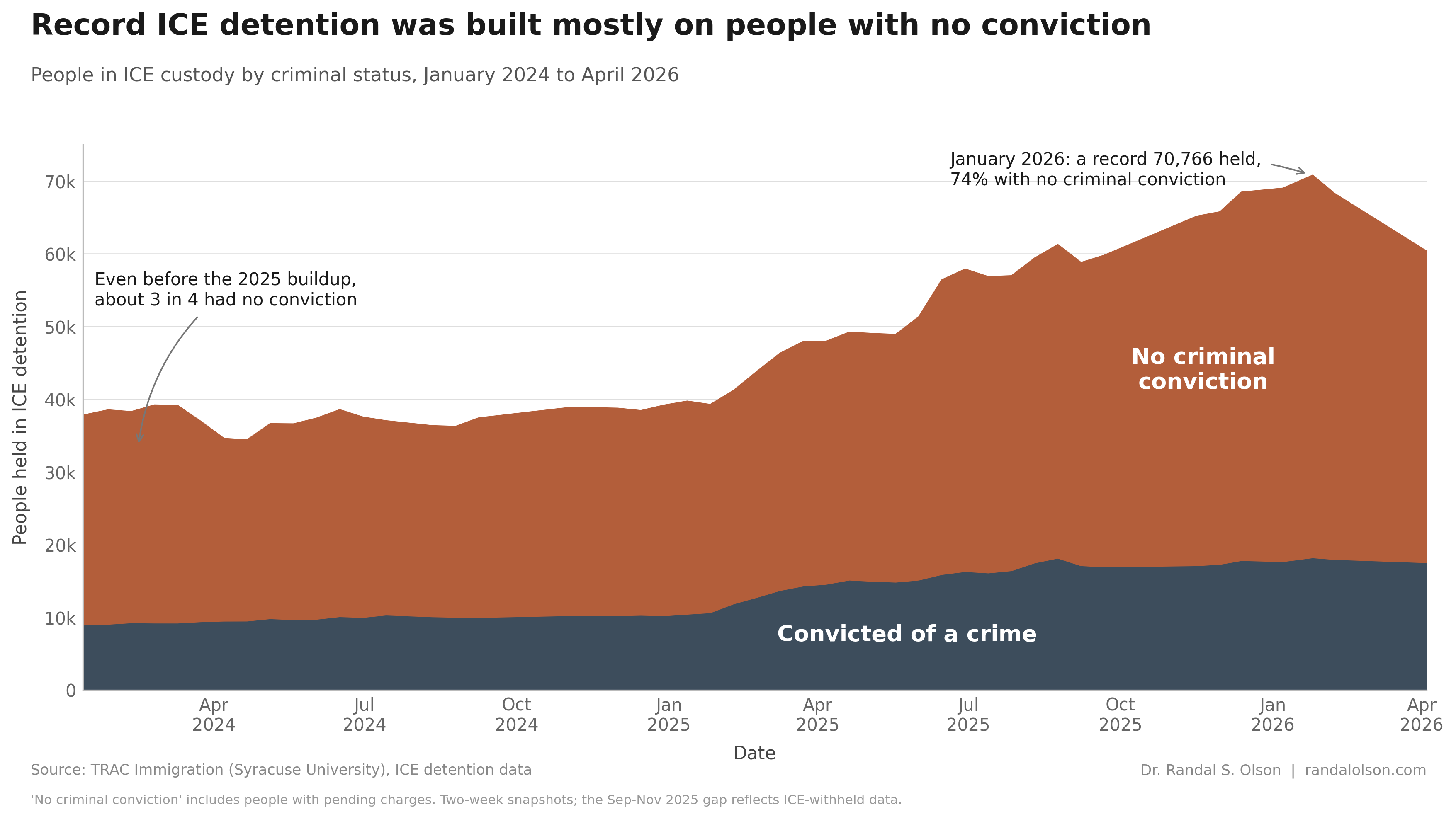
The chart splits everyone held in ICE custody into two groups: people convicted of a crime, and people with no conviction. The total rises and falls with how many ICE is holding at any given time.
A record number of people are in ICE detention
In late January 2026, ICE held 70,766 people, the most it had ever held at once and the first time the agency topped 70,000. The detained population had roughly doubled off its 2024 lows before easing back to about 60,000 by April.
That growth was bankrolled. A $75 billion windfall in the summer of 2025 made ICE the highest-funded law enforcement agency in the federal government and let it double its ranks in a matter of months. The June 2026 package, about $38 billion of it earmarked for ICE, locked in that footing through the rest of the president's term.
Almost all of the growth has been people with no conviction
About 3 of every 4 people added to detention during the 2025 buildup had no criminal conviction. The number of convicted people in custody did rise too, but far more slowly, and they have stayed a clear minority of everyone held.
TRAC's own accounting is starker over the sharpest stretch. Between September and November 2025, detention grew by 5,373 people, and 5,209 of them, about 97%, had no criminal conviction. The same shift shows up at the arrest stage: the share of people ICE arrested who had no criminal record at all climbed from about 22% in early 2025 to roughly 40% by that fall.
It was never mostly criminals, even before the crackdown
Even in early 2024, under the prior administration, about 3 in 4 ICE detainees had no criminal conviction. The share has sat between about 69% and 76% across the entire span the chart covers.
That is the part the "worst of the worst" framing skips. The no-conviction share is not a number the 2025 surge drove up. It is a baseline that held steady while the system around it more than doubled in size.
What "no criminal conviction" does and does not mean
"No criminal conviction" is not the same as "no record." It includes people with pending charges who have not been convicted of anything. Strip those out and the picture is still striking: as of early January 2026, about 48% of detainees had neither a conviction nor a pending charge, and by April that share was about 40%.
The convictions that do exist are not all serious, either. TRAC notes that many of those counted as convicted committed only minor offenses, including traffic violations. When PolitiFact checked the claim that roughly 70% of detainees had been convicted of or charged with a crime, it did not hold up: even counting pending charges, closer to half had neither. None of this says no one in ICE custody is dangerous. It says the detained population is mostly people the system has not convicted of anything, and that this was true before the latest expansion and stayed true through it.
How this chart was made
This chart was built and self-critiqued by an AI agent. See the full series: Teaching an AI Agent to Make Beautiful Charts.
Data source: Immigration Detention Quick Facts and the biweekly detention series from TRAC Immigration at Syracuse University, based on ICE detention data. "No criminal conviction" combines TRAC's pending-charges and other-immigration-violator categories, so it includes people with charges that have not led to a conviction. The two-week snapshots run from January 2024 through April 4, 2026, with a Sep-Nov 2025 gap that reflects data ICE withheld during the federal shutdown. The cleaned dataset is available here.

Dr. Randal S. Olson
AI Researcher & Builder
I’ve worked in AI for 15+ years, from academic research to production systems at startups. I’m building things independently for now.