The 2026 NBA Finals drew the biggest TV audience since 1998
Part of Teaching an AI Agent to Make Beautiful Charts
For a couple of years now, the story about the NBA has been that nobody watches it anymore. Cord-cutting, load management, too many 3-pointers, a generation that would rather catch the highlights on a phone than sit through a broadcast. The ratings backed it up. Then the 2026 Finals doubled last year's audience and pulled the biggest crowd the league has had in front of a television since 1998.
The decline was real
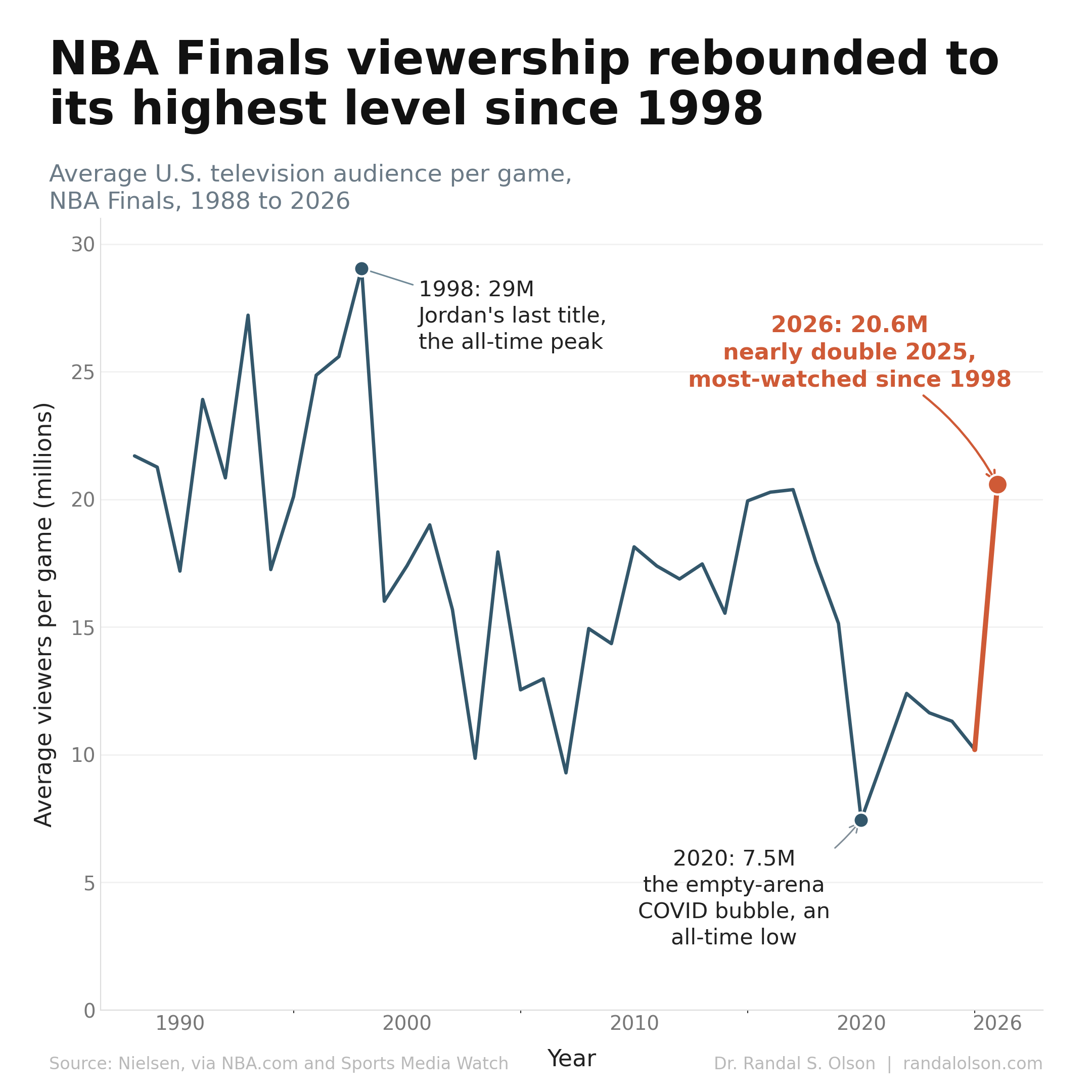
The skeptics were not making it up. NBA Finals viewership peaked in 1998, when Michael Jordan won his sixth title with the Bulls and 29 million people a night tuned in. Game 6 of that series is still the most-watched NBA game ever, at 35.9 million. Nothing since has come close.
From there it slid for 2 decades. By 2025, the Thunder-Pacers Finals drew 10.2 million viewers a night, roughly 1/3 of the 1998 audience. Some of that is the NBA's problem and some of it is everyone's: young viewers increasingly watch the league as short highlight clips rather than live broadcasts, and cable kept shedding the households that used to make a championship a default event.
2020 was the floor
The low point came in the strangest season. The 2020 Finals drew just 7.5 million viewers a night, the smallest NBA Finals audience on record. The games were played in a sealed bubble in Orlando with no fans, pushed to October by the pandemic, and stacked against an election news cycle and Sunday night football. Almost everything that could pull eyeballs away was working at once.
Then the Knicks doubled it
The 2026 Finals reversed all of it. The New York Knicks won their first championship in 53 years, since 1973, and they did it in the country's largest media market against a San Antonio Spurs team built around Victor Wembanyama, the most hyped young player in the league. That is about as good as a TV matchup gets.
The games delivered too. The Knicks erased a 29-point deficit in Game 4, the largest comeback in Finals history, and closed it out in Game 5 in front of 24.5 million viewers that peaked at 33 million at the buzzer. The series averaged 20.6 million viewers a night, double the 2025 number and the most since 1998. By the NBA's count, the series also racked up a record 15 billion video views on social media, nearly triple the prior year. The clips and the broadcast, it turns out, are not a zero-sum fight.
Why 2026 still isn't 1998
Now, the honest asterisk. The viewership counts are not measured the same way across this whole chart. In late 2020 Nielsen started counting out-of-home viewing, the people watching in bars, gyms, and other households, and later expanded it to every market in the lower 48 states. Live sports gained the most from that change, so recent totals get a lift the 1998 figure never got.
You can see it in the household ratings, which are measured more consistently. The 2026 Finals scored a 10.0 household rating against 1998's 18.7, a 47% drop, even though the raw viewer count was only 29% lower. So 2026 is not really back to Jordan-era reach. Strip out the measurement boost and it was probably still the best since 2017. Either way, a league that was supposedly dying just posted its biggest Finals in a generation, and a lot of people watched.
How this chart was made
An AI agent built this chart end-to-end as part of the Beautiful Charts with AI series. It compiled the year-by-year Nielsen viewership figures, built the chart in Python, and iterated on the design until it passed the Tufte Test, a data visualization quality standard from Goodeye Labs. The workflow behind it is public: run the same high-signal chart workflow to make your own.
Data source: average NBA Finals viewership per game, compiled from Nielsen figures published by Sports Media Watch and cross-checked against Sportico's reporting on the 2026 series and the 2020 to 2026 measurement change. The dataset used for this chart is available here.
Beautiful Charts with AI
Make your own charts with the same workflow
Every chart in this series is built by the same public workflow. Fork it and run it yourself, then grade the result against the Tufte Test.

Dr. Randal S. Olson
AI Researcher & Builder · Co-Founder & CTO at Goodeye Labs
I’ve worked in AI for 15+ years. At Goodeye Labs, we build AI products that point frontier models at the business outcomes a team actually cares about.