U.S. World War II veterans are fading from living memory
Part of Teaching an AI Agent to Make Beautiful Charts
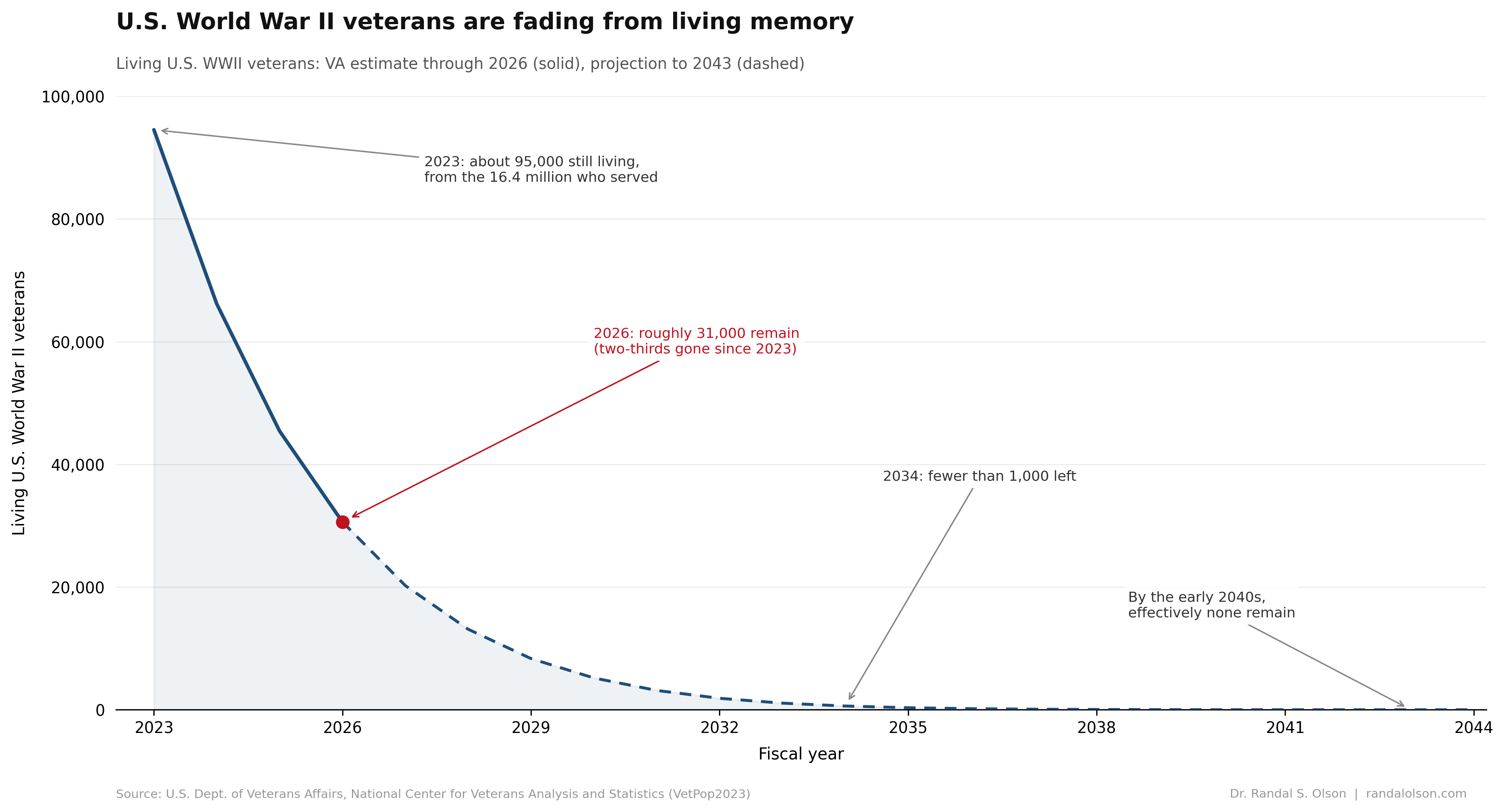
Roughly 16.4 million people served in the U.S. armed forces during World War II. As of 2026, the Department of Veterans Affairs projects that about 31,000 of them are still alive. That is fewer than 1 in 500 of the people who wore the uniform, and the number is dropping fast. This week marks 82 years since the D-Day landings, which makes it a fitting moment to look at how quickly the last of that generation is leaving us.
16.4 million served. About 31,000 are left.
Of those 16.4 million, more than 405,000 died during the war itself, according to the National WWII Museum. The survivors came home, built careers and families, and for decades were a visible part of civic life.
By 2026, the VA projects only about 31,000 are still living. That is under 0.2% of everyone who served. In 2023 the same model counted about 95,000.
The decline is accelerating
This is not a gentle slope anymore. The VA's VetPop2023 model counted about 95,000 living WWII veterans in fiscal 2023 and projects about 31,000 by fiscal 2026.
That is more than two-thirds of the 2023 survivors, gone in 3 years. The reason is straightforward: the youngest WWII veterans are now in their late 90s, and most are past 100. The VA's figures imply the count is falling by more than 14,000 a year right now, about 40 every day.
D-Day's last witnesses
On June 6, 1944, nearly 160,000 Allied troops came ashore in Normandy, and about 73,000 of them were from the United States, per the National WWII Museum. They were the visible, living link to the largest amphibious invasion in history.
The 80th anniversary in 2024 was widely described as likely the last major D-Day commemoration with living veterans present. CNN reported that even the youngest survivors were nearing 100, and that organizers treated the gathering as a final chance to honor them in person. Two years later, that window has narrowed further.
By the 2030s, a vanishing few
The projection does not level off at a few thousand. It keeps falling. The VA expects fewer than 10,000 living WWII veterans by 2029 and fewer than 1,000 by 2034.
At that point the survivors would be about 107 years old or older. A handful of supercentenarians may stretch the timeline slightly, but the trajectory is set by basic demography, not by any single uncertain assumption.
When the last veteran dies, World War II leaves living memory
By the early 2040s, the VA projects that essentially no living WWII veterans will remain. When the last one dies, World War II will pass entirely out of living memory, the way earlier wars already have.
The last U.S. veteran of World War I, Frank Buckles, died in 2011 at age 110. The last surviving Union veteran of the Civil War, Albert Woolson, died in 1956. Each death marked the moment a war stopped being something anyone alive had seen firsthand. World War II is now approaching that same threshold within the next 20 years.
How this chart was made
An AI agent built this chart end-to-end as part of the Beautiful Charts with AI series. It researched the data, built the chart in Python, and iterated on the design until it passed its own chart-quality review.
Data source: U.S. Department of Veterans Affairs, National Center for Veterans Analysis and Statistics, VetPop2023 (living veterans by period of service, Table 2L). The figures of 16.4 million who served and 405,399 wartime deaths come from the National WWII Museum. The dataset used for this chart is available here.

Dr. Randal S. Olson
AI Researcher & Builder
I’ve worked in AI for 15+ years, from academic research to production systems at startups. I’m building things independently for now.