U.S. abortions rose after Dobbs, driven by mailed pills
Part of Teaching an AI Agent to Make Beautiful Charts
The widely shared story about the Dobbs decision is simple: the Supreme Court let states ban abortion, bans spread across the South and Midwest, so abortions fell. The first half is right. The second half is not. Since the Court overturned Roe in June 2022, the number of abortions in the U.S. has gone up, not down.
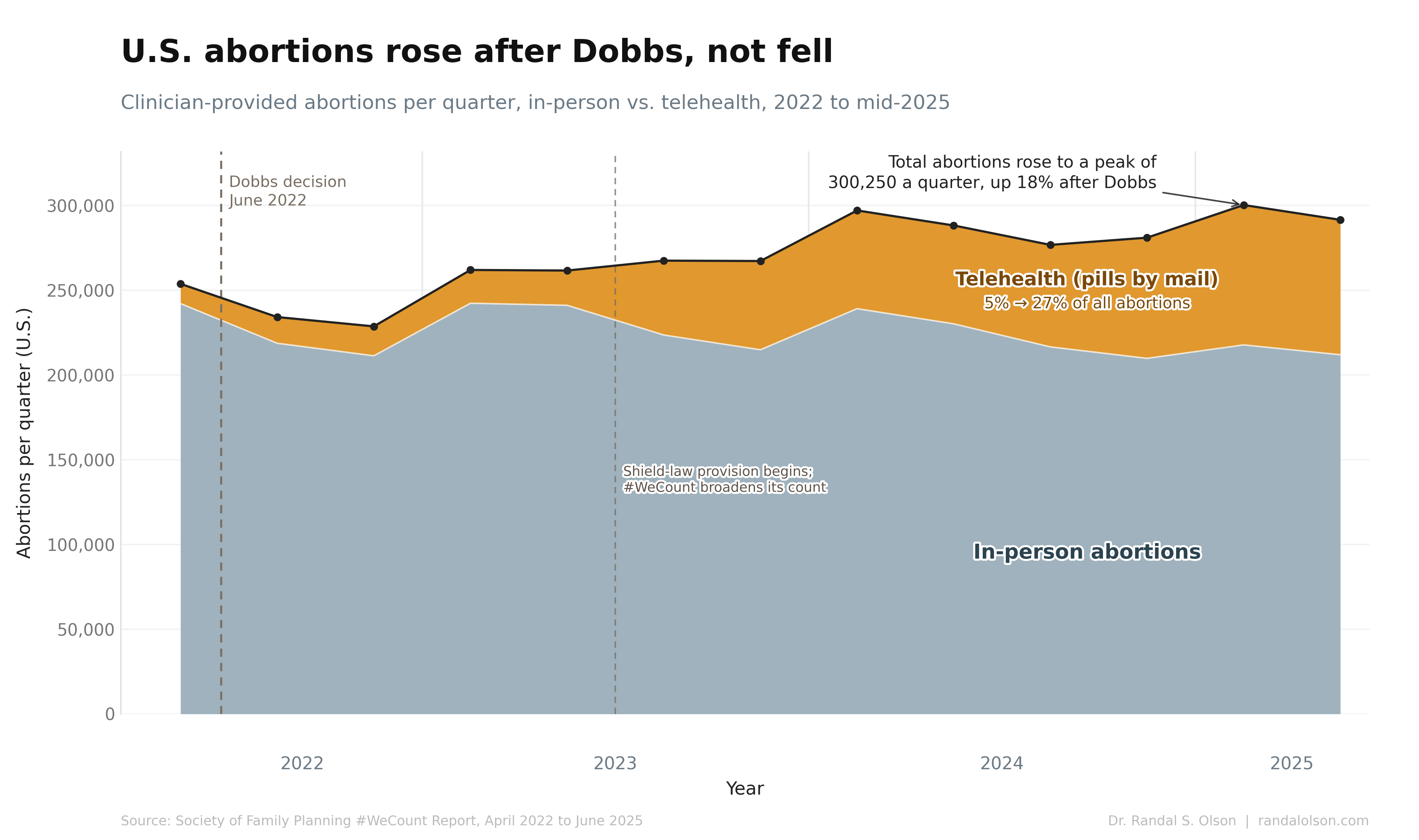
If the bans had cut the number of abortions, the line would fall. It doesn't. The national count rose roughly 18% to its early-2025 peak, and one thing accounts for the entire increase: abortion pills in the mail.
The national total went up, not down
Spring 2022, the last full quarter mostly before the ruling, saw about 253,750 abortions in the U.S. health care system. By early 2025 the quarterly figure peaked at 300,250. The monthly average climbed every year since: 79,600 in 2022, 88,200 in 2023, 95,300 in 2024, and 98,800 in the first half of 2025. January 2025 was the single biggest month on record for this count, with 107,740 abortions.
This is not a single tracker's quirk. Guttmacher, counting on a different method, found more than 1 million abortions in the formal health care system in 2023, the most since 2012. Two independent efforts that disagree on the exact numbers agree on the direction: up.
The whole increase is pills in the mail
Split the total into in-person care and telehealth and the mechanism is obvious. In-person care, the lower band, actually fell about 12%, from 242,110 abortions a quarter to 211,930. Telehealth, the band stacked on top, went from 5% of all abortions to 27%, growing nearly 7 times over in absolute terms. That single band added about 68,000 abortions a quarter, more than enough to cover the in-person decline and push the total higher.
Telehealth here means a clinician consults with a patient remotely and mails mifepristone and misoprostol, the drugs used for a medication abortion. Medication abortion is now the majority of U.S. abortions, about 63% in 2023. The rise after Dobbs did not come from more clinics. It came from the mailbox.
Shield laws carried the pills into ban states
The pills increasingly go to the places that banned the procedure. 13 states enforce total bans, and in those states nearly all the abortions still happening are telehealth pills mailed in from providers in other states. Those providers work under shield laws, state protections that a handful of states first enacted in 2023. By June 2025 shield-law providers were mailing roughly 14,770 abortions a month.
One honest caveat lives at the mid-2023 marker on the chart: that is when shield-law provision began and the #WeCount project broadened its data collection, so part of the 2023 jump is better measurement rather than pure growth. The trend holds without it, since telehealth kept climbing for 2 more years. Travel did the rest. More than 169,000 people, about 1 in 6, crossed state lines for an abortion in 2023, double the share in 2020. Bans changed how and where people got abortions, not whether.
What the count leaves out
This chart only counts abortions provided by licensed clinicians. It leaves out self-managed abortions, the pills people get outside the formal system through networks like Aid Access or overseas pharmacies, which jumped by tens of thousands of requests in the months after Dobbs. The 2022 and 2025 windows are also partial years, and #WeCount imputes 19% to 28% of its counts.
Every one of those gaps points the same way: the true national total is higher than the chart shows, not lower. The count is a floor.
The fight moved to the pills
Because the pills are now the story, the legal fight is too. In May 2026 the Supreme Court left mifepristone available by mail and telehealth while Louisiana v. FDA moves through the courts, and the FDA moved ahead with a new safety review of a drug it approved 25 years ago. States are fighting over the shield laws directly: Texas fined a New York doctor more than $100,000 for mailing pills into the state, Louisiana indicted her, and New York refused to extradite her. Abortion is back on the 2026 ballot in Missouri, Nevada, and Virginia.
The data does not tell anyone which side is right, and it is not meant to. It says the simplest version of the post-Dobbs story, the one where bans cut the number of abortions, is not what the numbers show. Whatever the bans did, they did not lower the count. They moved it into the mail.
How this chart was made
An AI agent built this chart end-to-end as part of the Beautiful Charts with AI series. It pulled the quarterly figures from the #WeCount report, built the chart in Python, and iterated on the design until it passed its own chart-quality review.
Data source: the Society of Family Planning's #WeCount Report, April 2022 to June 2025 (released December 9, 2025), which counts clinician-provided abortions including telehealth and shield-law provision and excludes self-managed abortions. The quarterly dataset used for this chart is available here.

Dr. Randal S. Olson
AI Researcher & Builder
I’ve worked in AI for 15+ years, from academic research to production systems at startups. I’m building things independently for now.