GLP-1 use peaks in middle age, then drops at 65
Part of Teaching an AI Agent to Make Beautiful Charts
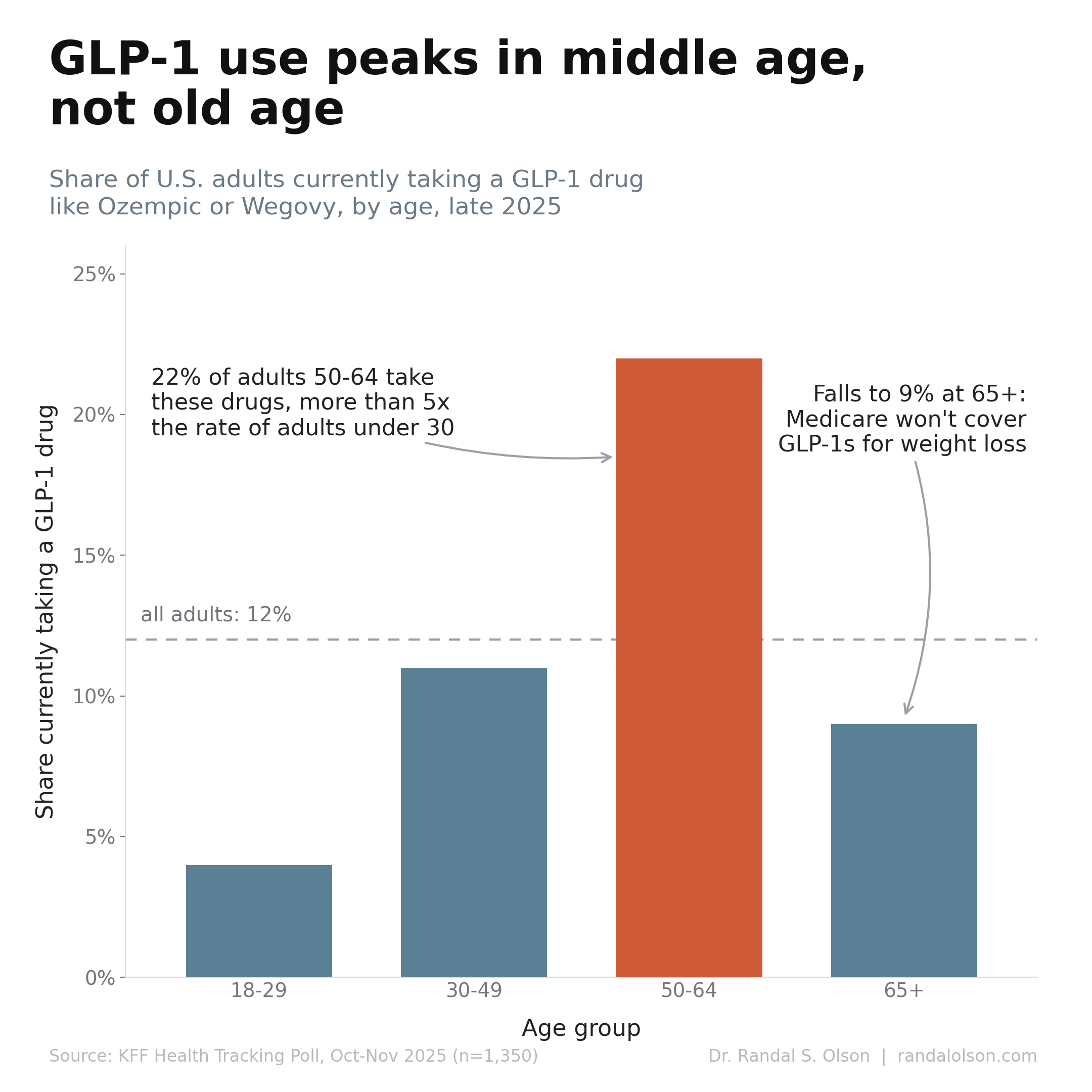
The easy guess about GLP-1 drugs like Ozempic and Wegovy is that the people most likely to take them are the oldest and the heaviest: the group with the most diabetes and the most years of accumulated weight. The data says otherwise. Use of these drugs peaks in middle age, then falls off a cliff right at 65.
About 1 in 8 U.S. adults now takes a GLP-1, but that average hides a sharp pattern by age.
The peak is middle age
More than 1 in 5 adults aged 50 to 64 (22%) currently take a GLP-1, against just 4% of adults under 30. That is more than 5 times the rate of the youngest adults, and nearly double the 12% average across all adults. Women are also more likely to be on them than men, 15% to 9%.
Middle age is where the conditions these drugs treat, obesity and type 2 diabetes, become common, and where most people still have private insurance or the income to cover a drug that has listed at more than $1,000 a month.
Use drops right at 65
The fall at 65 is not about health. Adults 65 and older have the highest diabetes rate of any age group, about 29%, yet their GLP-1 use drops to 9%, below the middle-aged group and below the national average. The reason is Medicare.
A 2003 law bars Medicare's Part D drug benefit from covering any medication used for weight loss. Medicare will pay for a GLP-1 prescribed for diabetes or heart disease, the uses it treats as medical, but not for weight loss alone. So the weight-loss demand that drives the 50-64 peak largely disappears at 65, when private insurance gives way to Medicare.
The number doubled in 18 months
This is a recent surge. In May 2024, 6% of adults said they were currently taking a GLP-1. By late 2025 that had doubled to 12%. As many adults are on a GLP-1 today as had ever tried one a year and a half ago. Counting everyone who has used one at some point now puts ever-use at 18%.
Price is still the wall
Cost gates who gets them. Half of GLP-1 users told KFF the drugs are difficult to afford, and the brand-name versions have run past $1,000 a month at list price. Even at the middle-age peak, price holds use well below the number of people who would medically qualify.
The cliff at 65 is about to move
That cliff is about to get smaller. After scrapping a Biden-era plan to cover obesity drugs in early 2025, the Trump administration reversed course: it struck deals with Novo Nordisk and Eli Lilly in November 2025 to cut GLP-1 prices, and a voluntary Medicare demonstration begins July 1, 2026 that lets participating drug plans cover GLP-1s for weight loss with a $50 monthly copay. If it holds, the right end of this chart could look very different a year from now.
How this chart was made
An AI agent built this chart end-to-end as part of the Beautiful Charts with AI series. It pulled the age breakdown from the KFF Health Tracking Poll, built the chart in Python, and iterated on the design until it passed the Tufte Test, a data visualization quality standard from Goodeye Labs. The workflow behind it is public: run the same high-signal chart workflow to make your own.
Data source: the KFF Health Tracking Poll, fielded October 27 to November 2, 2025 among 1,350 U.S. adults (margin of error +/- 3 percentage points). Current GLP-1 use by age is reported in KFF's writeup of the poll. The dataset used for this chart is available here.
Beautiful Charts with AI
Make your own charts with the same workflow
Every chart in this series is built by the same public workflow. Fork it and run it yourself, then grade the result against the Tufte Test.

Dr. Randal S. Olson
AI Researcher & Builder · Co-Founder & CTO at Goodeye Labs
I’ve worked in AI for 15+ years. At Goodeye Labs, we build AI products that point frontier models at the business outcomes a team actually cares about.